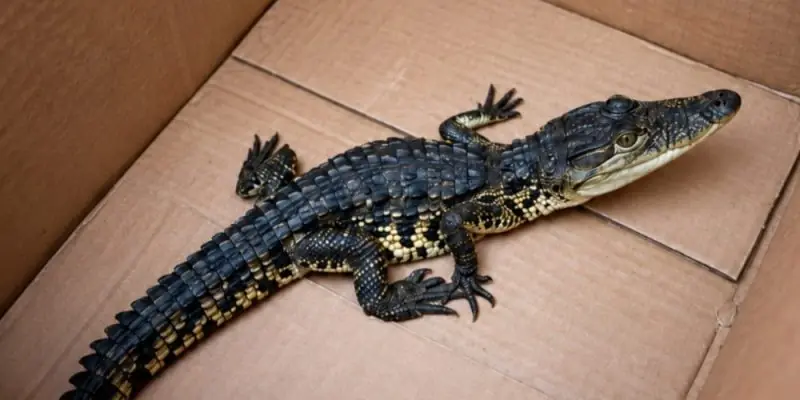
A small crocodile turned up on a walking trail at the Holtsville Wildlife & Ecology Center in Long Island, New York, leaving local officials with an unusual question: How did the reptile get there?
The animal was found on Thursday, Sept. 17, while the facility was closed for the season. Officials later identified it as a Morelet’s crocodile, a species not native to New York.
The discovery has now led to an investigation involving state and local authorities. Strong Island Animal Rescue League (SIARL) is also offering a $1,000 reward for information that leads to the arrest and conviction of the person responsible for dumping the animal.
Crocodile Found on Walking Trail
Town employees discovered the reptile along an exercise path at the Holtsville facility. Staff members who cared for the property kept watch over the animal and contacted Strong Island Animal Rescue League for assistance.
The nonprofit responds to local calls involving injured, abused, and neglected animals. New York State Department of Environmental Conservation (DEC) officers were also notified after the animal was reported as a small reptile that appeared to have been abandoned.
At first, the animal was incorrectly described as an alligator. DEC officials later confirmed that it was a Morelet’s crocodile.
SIARL President Frank Floridia went to the location to assist with the rescue. However, the animal had already been safely contained by the time he arrived.
Reptile Was Safely Contained
SIARL shared details of the incident on Facebook, along with a video showing the crocodile sitting inside a cardboard box. The organization said staff members managed to keep an eye on the animal and contain it until help arrived.
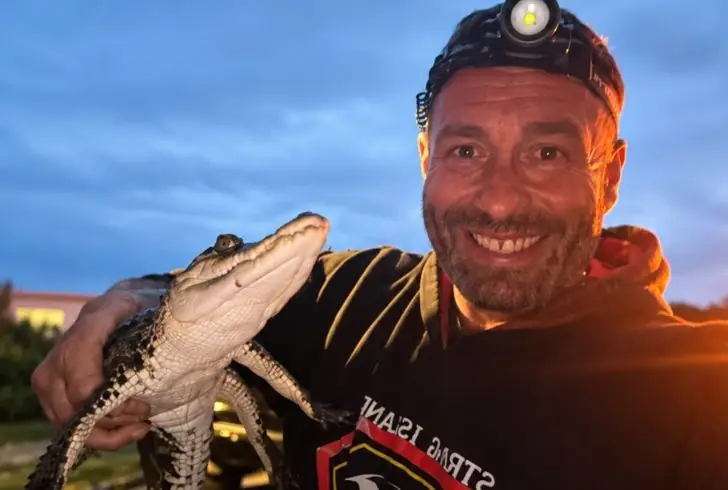
Floridia later handled the crocodile during a follow-up visit. He said the reptile was not aggressive when he picked it up.
“I grabbed him mid-back, so his tail couldn’t get me and his face couldn’t get me,” Floridia told PEOPLE.
Still, he warned that the animal could have seriously injured someone if it had bitten them.
“Let me tell you, if he bit somebody, you’re gonna feel it,” Floridia explained. “It can tear your ligaments. It can seriously hurt somebody.”
The incident also raised concerns about the crocodile’s welfare. Floridia said the animal did not have the habitat or environment it needed to survive properly.
Officials Search for Answers
The day after the crocodile was found, SIARL said it searched the surrounding area but found no signs of a tank or another reptile. The group later announced a $1,000 reward for information that could lead to the arrest and conviction of the person responsible for dumping the crocodile.
The DEC is also investigating the incident. A spokesperson told PEOPLE that officials are working to identify the person or people who unlawfully released the animal.
The Suffolk County Society for the Prevention of Cruelty to Animals (SPCA) is investigating as well. Suffolk County SPCA Chief Roy Gross told Patch that the crocodile clearly did not belong in the area’s natural waters.
“Obviously, it’s not indigenous to these waters here,” Gross said. He added that officials were treating the case as abandonment while investigating how the animal arrived at the facility.
What Is a Morelet’s Crocodile?
Morelet’s crocodiles are native to Belize, northern Guatemala, and parts of Mexico, according to Encyclopedia Britannica. Their natural range makes the Long Island discovery particularly unusual.
After DEC officers took possession of the reptile, it was placed with the Nassau County SPCA. As of Monday, Sept. 21, the agency said the crocodile was awaiting final transfer to a properly permitted facility.
The case also highlights New York’s rules concerning exotic reptiles. According to the DEC, it is unlawful in New York to import, possess, or sell an alligator, caiman, or crocodile, including parts and products made from these animals, without the proper DEC permits.
The Investigation Continues
The crocodile was removed without reported injuries, but authorities are still trying to determine who brought it to the Holtsville property and why. The $1,000 reward remains part of SIARL’s effort to identify the person responsible.
For now, the Morelet’s crocodile remains under proper care while officials investigate its origin and arrange an appropriate placement. The unusual discovery has also drawn attention to the responsibilities involved in keeping exotic animals and the risks of releasing them without authorization.
The abandoned crocodile found at the Holtsville Wildlife & Ecology Center has prompted investigations by the DEC, Suffolk County SPCA, and Strong Island Animal Rescue League. While the reptile was safely contained, officials say its presence created potential risks for both people and the animal.
The investigation will now focus on determining how the Morelet’s crocodile reached the Long Island walking path and who left it there.