
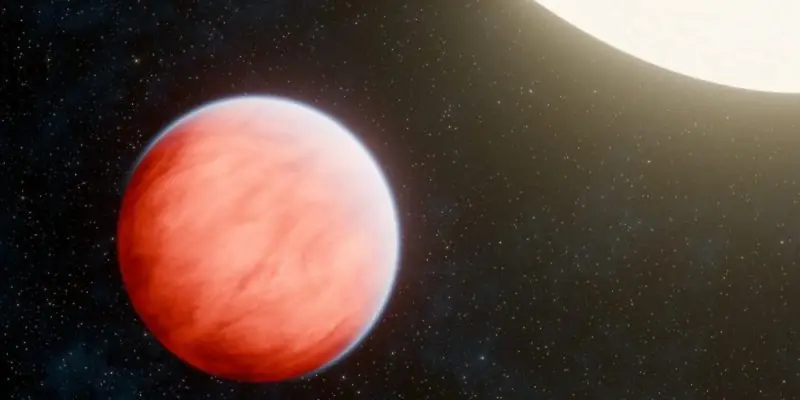
Hot Jupiters are among the most extreme planets found beyond the solar system. These giant gas planets orbit so close to their stars that their years can last only a few days. A new study of one unusual world, CoRoT-2 b, is forcing astronomers to rethink how these planets rotate, distribute heat, and interact with their host stars.
Located about 696 light-years away, CoRoT-2 b is a massive exoplanet with around 3.5 times the mass of Jupiter and about 1.5 times its size. The planet completes an orbit around its star in roughly 41 hours, making it one of the many hot Jupiters that experience intense stellar radiation.
A Hot Jupiter That Breaks the Rules
Most hot Jupiters are believed to be tidally locked. This means the same side of the planet always faces its star, creating a permanent dayside and a permanent nightside. The strong gravity between the planet and its star gradually slows the planet’s rotation until the two sides remain fixed.
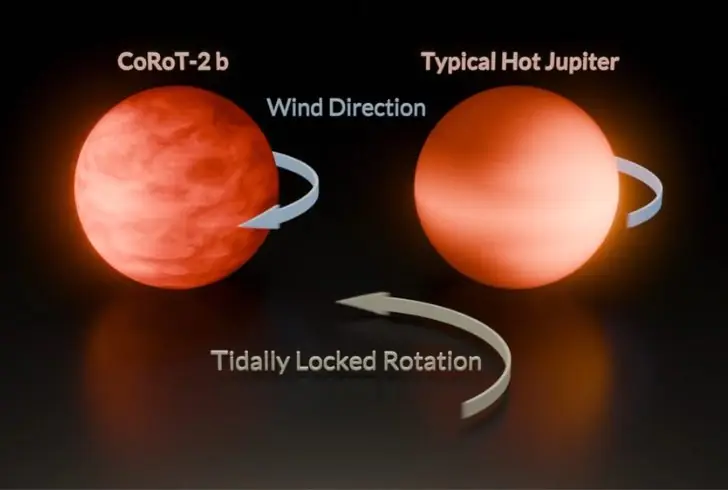
CoRoT-2 b appears to challenge this common pattern. New observations suggest that the planet is not fully tidally locked. The finding is surprising because many models of hot Jupiters depend on the idea that these planets quickly settle into this synchronized rotation.
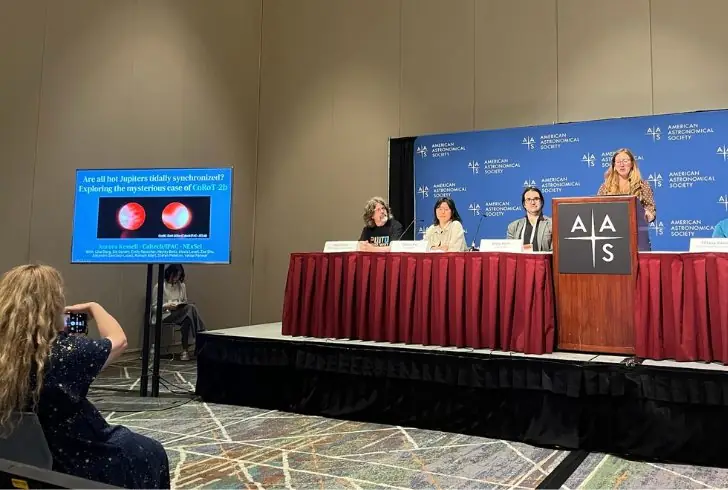
Aurora Kesseli of the NASA Exoplanet Science Institute (NExScI), who led the research team, explained the importance of studying unusual planets. “I really like looking at the weird ones — finding planets that don’t fit the standard picture — and doing some mystery solving,” Kesseli said.
The discovery suggests that hot Jupiters may not all follow the same physical rules. Kesseli added, “Now we can see that a one-size-fits-all model does not work, even for planets that we’ve been studying for a long time.”
CoRoT-2 b’s Strange Heat Pattern
The unusual rotation of CoRoT-2 b is not the only mystery. Hot Jupiters usually have a large hotspot on their dayside. Because of powerful atmospheric winds, these hotspots are normally shifted slightly ahead of the point directly facing the star, following the direction of the planet’s orbit.
CoRoT-2 b does the opposite. Its hotspot appears to sit on the wrong side, moving against the expected direction. Researchers explored three possible explanations for this strange behavior, including the possibility that the planet’s rotation plays a major role.
Understanding rotation is important because it controls how heat moves across a planet. For rocky planets, tidal locking can create extreme temperature differences between the bright side and the dark side. For gas giants, complex atmospheric movements make the process harder to predict.
Kesseli noted that tidal locking also matters when studying planets around small stars. “The way that a planet rotates greatly affects how the planet distributes its heat, and therefore affects its habitability,” she said.
A Day Longer Than Expected
To understand CoRoT-2 b’s movement, researchers measured the planet’s velocity and found that one rotation takes about three Earth days. This is nearly twice as long as the planet’s year, which lasts around 1.5 Earth days.
CoRoT-2 b rotates slowly compared with its orbit. During one rotation, the planet completes nearly two trips around its star. This discovery supports a possible explanation for the planet’s unusual hotspot. It also suggests that some hot Jupiters may have more complex behavior than scientists previously believed.
Kesseli described the result as exciting, saying, “I was very pleasantly surprised when I tried a bunch of methods, and I was like, ‘Aha! This is actually like one of the three hypotheses!’”
What CoRoT-2 b Could Teach Scientists
The next challenge is finding out why CoRoT-2 b rotates more slowly than expected. The answer could help researchers build better climate models for gas giants and improve the understanding of planets beyond the solar system.
“Hot Jupiters are the first type of planet where we have been able to deeply study and improve our climate models,” Kesseli said. Future observations from advanced telescopes, such as the Habitable Worlds Observatory and the Extremely Large Telescope, could offer more detailed information about distant planets.
CoRoT-2 b shows that even well-studied exoplanets can still surprise astronomers. Its unusual rotation and misplaced hotspot reveal that planetary systems are more varied than simple models suggest. Each strange world adds new information about how planets form, evolve, and manage their extreme environments.